
STEAM-3D: Building sustainable modelling expertise across sub-Saharan Africa
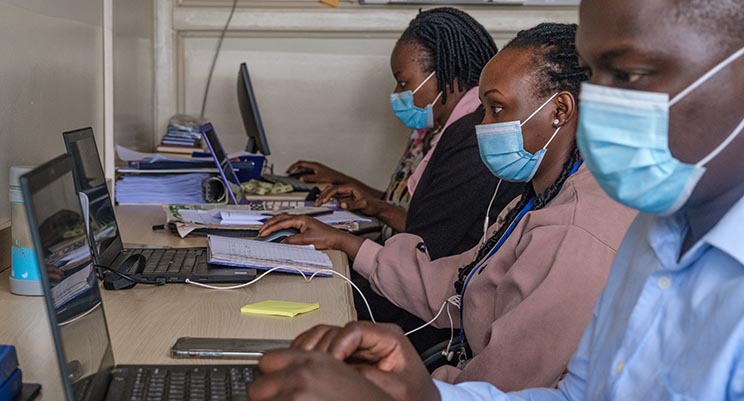
STEAM-3D, the Sustainable Training in Epidemiological Analysis and Modelling for Data-Driven Decision Making in Africa project, is a three-year initiative supported by Global Health EDCTP3 to strengthen epidemiological, statistical and mathematical modelling skills in sub-Saharan Africa. Bringing together six partners from Belgium, Cameroon, Malawi, Mozambique, the Netherlands and South Africa, the project will deliver multidisciplinary training designed to build lasting capacity and support policy impact.
This initiative aims to strengthen epidemiological, statistical and mathematical modelling capacity in sub-Saharan Africa through training, support and mentorship, helping to build a sustainable pipeline of African researchers with expertise in modelling and biostatistics.
Closing critical gaps in infectious disease modelling
Sub-Saharan Africa is particularly vulnerable to emerging infectious diseases due to limited healthcare infrastructure, socioeconomic factors, and environmental conditions. Responding effectively requires robust, reliable, and timely data collection systems and analytical expertise to transform the data into actionable insights for public health decision-making.
While previous short-term training initiatives have helped strengthen modelling capacity in sub-Saharan Africa, many of these approaches lacked long-term sustainability and training on how to translate findings into practice or policy. STEAM-3D aims to close these gaps by training students to identify, address and manage deficiencies in disease and demographic data used to estimate mortality, morbidity and burden of disease.
A regional partnership with a shared goal
The project is led by Professor Tarylee Reddy of the South African Medical Research Council (SAMRC)’s Biostatistics Research Unit and is being implemented in collaboration with several SAMRC research units, including the Cochrane South Africa, Health Systems Research Unit, Burden of Disease Research Unit, and HIV and Other Infectious Diseases Research Unit. International partners from Cameroon (Douala General Hospital), Mozambique (Universidade Eduardo Mondlane), Malawi (University of Malawi), and Belgium (Universiteit Hasselt) are supporting the development and delivery of training materials and platforms in Lusophone, Francophone, and Anglophone contexts.
The project’s main objectives are to:
- strengthen infectious disease modelling expertise in Sub-Saharan Africa;
- increase the use of data and modelling evidence in public health policy; and
- establish a sustainable educational framework for long-term capacity development.
To achieve this, STEAM-3D will train about 150 experts in advanced analytical and predictive modelling techniques through workshops, mentoring and hands-on learning. Participants will gain skills they can apply to local datasets to support faster outbreak responses and more locally relevant evidence for decision-making.
The project will also develop interactive dashboards, policy briefs and recommendations to help translate modelling evidence into policy and public health action.
In addition, STEAM-3D will create free, multilingual online education and research resources in English, Portuguese and French, supporting continued knowledge sharing beyond the life of the project.
“STEAM-3D is empowering an African-led ecosystem of modelling excellence that unites researchers across linguistic divides, ensuring that innovation is inclusive, locally driven, and globally impactful.”
Tarylee Reddy, Biostatistics Research Unit Director, South African Medical Research Council
Training, collaboration and innovation
STEAM-3D combines advanced technical training, applied research, cross-country collaboration, mentorship, and sustainable capacity development. The programme is designed not only to build technical expertise, but also to help participants to translate modelling evidence into policy and public health practice.
The project will use an interdisciplinary and practice-oriented training model that integrates mathematical and statistical modelling, artificial intelligence (AI), machine learning (ML), wastewater-based epidemiology, burden of disease methodologies, and knowledge translation.
Annual regional workshops will train approximately 40 participants from National Public Health Institutes (NPHIs) and research institutions each year. In the first two years, the workshops will focus on participants from South Africa, Cameroon, Malawi, and Mozambique, with expansion to additional sub-Saharan African countries in year three.
Training will combine lectures, practical exercises, group projects, mentoring, and collaborative problem-solving. Participants will work with publicly available datasets alongside country-specific data, and participating institutions will compile national infectious disease databases that will be analysed throughout the training programme.
STEAM-3D will also establish a shared data repository across partner institutions to facilitate secure data sharing, collaborative analyses, and multi-country modelling projects. Analytical software, AI and machine learning will be used to develop predictive models, evaluate forecasting performance, quantify uncertainty, and generate interactive dashboards for policymakers and other stakeholders.
“This project will help build a stronger, more connected modelling community across sub-Saharan Africa, supporting long-term collaboration, locally driven evidence and sustainable public health impact.”
Ms Nuraan Fakier, Project Officer, EDCTP Association, South Africa
Strengthening health security across the region
The project supports regional and global priorities by strengthening infectious disease preparedness, surveillance, and evidence-informed decision-making across sub-Saharan Africa. It also aligns with Africa CDC priorities to strengthen public health institutions, expand the epidemiology and public health workforce, improve disease surveillance, and increase the use of data for decision-making.
By training researchers and public health professionals from National Public Health Institutes and academic institutions, STEAM-3D contributes to developing a skilled workforce capable of responding rapidly to disease outbreaks using locally generated evidence.
The project’s multilingual training materials (English, Portuguese and French) will improve access to high-quality educational resources across Anglophone, Lusophone and Francophone countries, while open learning platforms and regional networks will help reduce inequities in research capacity and promote South–South collaboration.
STEAM-3D contributes directly to global efforts to strengthen pandemic preparedness and health security, and the global agenda for epidemic preparedness, as well as the United Nations Sustainable Development Goals (SDGs), including:
- SDG 3 (Good Health and Well-being)
- SDG 4 (Quality Education)
- SDG 9 (Industry, Innovation and Infrastructure)
- SDG 17 (Partnerships for the Goals)
A lasting legacy for African-led research
Beyond the project period, STEAM-3D aims to leave a sustainable legacy by creating an open-access educational platform, shared data resources, and a regional network of infectious disease modelling experts. These resources will continue to support workforce development, collaborative research, and evidence-informed policymaking across sub-Saharan Africa.
Ultimately, the project will enhance Africa’s capacity to generate and apply its own scientific evidence, reducing reliance on external expertise while increasing the region’s contribution to global infectious disease research, surveillance, and public health policy. This will strengthen both regional resilience and the global capacity to detect, monitor, and respond to future infectious disease threats.
Background
The EDCTP Association acts as the Coordinator of several projects under Global Health EDCTP3 actions that use lump sum funding. As Coordinator, the Association is responsible for facilitating communication between the consortium and Global Health EDCTP3, financial administration by ensuring prompt distribution of payments to beneficiaries, submitting required reports and deliverables, and overseeing the effective project management with the Scientific Project Leader.
The STEAM-3D project is supported by Global Health EDCTP3 and its members.